
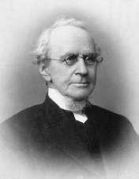
A Brief Biography of John Williamson Nevin
by Linden DeBie
[This biography first appeared as the Editor’s Introduction to The Mystical Presence and the Doctrine of the Reformed On the Lord’s Supper by John Williamson Nevin. It was volume 1 of the Mercersburg Theology Series published by Wipf and Stock in 2012. At the time Bradford Littlejohn was the series editor. I was responsible for the first edition. Very few changes have been made and all the changes are explained and cited in the footnotes. Small grammatical or stylistic changes are not mentioned.]
John Williamson Nevin was born on February 20, 1803, in Herron’s Branch, near Shippensburg, a quaint Pennsylvania farming community. Nevin’s father was a successful, well-educated gentleman farmer of Scots-Irish extraction who raised his children in the tradition of the Westminster Catechism. The children began their training with simple bible questions, followed by the Mother’s Catechism, then the Assembly’s Shorter Catechism, and finally the Assembly’s Larger Catechism. Indeed, the early emphasis on learning was specifically meant to foster induction into the Presbyterian religion.[1]
Likewise, church life was essential to that budding faith and fundamental to the young person’s experience of corporate religion. Preaching was central to the Reformed, and the sacraments played a vital role in the community’s shared religious experience. As we learn from Nevin’s biographical sketch, his fond memories of the sacramental seasons of the church, which were celebratory and protracted, instilled in him a passion for the Eucharist that would inspire his most famous work, The Mystical Presence.[2]In 1816 Nevin entered Union college in Schenectady, New York. At that time Union was under the leadership of Dr. Eliphalet Nott, whose skill as an administrator (and fund-raiser) had lifted the reputation of the institution considerably, so much so that the elder Nevin decided to enroll his son there in spite of his weak physical condition and what today we would recognize as mild depression. Indeed, Nevin’s “dyspepsia under its worst form” as it was called, was an early sign that Nevin would become a lifelong valetudinarian.[3]
Although Nevin was raised deeply confessional and schooled in the system of the catechism, he along with college students throughout the East was being exposed to popular religious revivals and to what the critics of this religious frame of mind (and Nevin later in life) would call “enthusiastic religion.” One of its chief marks was the experience of conversion which Nevin underwent in 1819–20, during his junior year. Later in life, Nevin would write that the whole experience was painful to him and the system misguided. At Mercersburg he became a leading voice warning Protestants against “new measures” revivalism and cautioned against its excesses as is evident in his popular tract, The Anxious Bench.[4] But here in Schenectady, at the mercy of the powerful evangelist and pulpiteer, Asahel Nettleton, Nevin fell in with the other students swayed by the emotional appeal of this dramatic movement.[5] In spite of physical and emotional troubles, Nevin graduated with honor in 1821.
Following his graduation, Nevin was undecided as to his future and any particular vocation. After some crooked halting, he decided to study at Princeton seminary, which turned out to be a safe and secure harbor for the anxiety prone young man. Here he was comforted by the warm religious sentiments of the beloved Archibald Alexander and edified by the influential historian Samuel Miller. Charles Hodge, who would become his rival during the Mercersburg years, had just joined the faculty and taught biblical languages. It was during Nevin’s study with Hodge that his life took a momentous turn. He was about to give up the study of Hebrew, questioning its usefulness, when his roommate advised him not to retreat but to master the subject. As a result Nevin became the best Hebrew scholar at Princeton and when Hodge went to Europe to study Greek and Hebrew, Nevin was appointed “assistant teacher” until Hodge’s return.[6] It was during those two years that he wrote his popular history called Biblical Antiquities based on the work of Jahn.[7] Nevin now had a vocation in mind: teaching.
Upon Hodge’s return Nevin was asked to fill the vacancy at the new Presbyterian seminary in Allegheny, Pennsylvania.[8] He joined Dr. Halsey on the faculty of Western Theological Seminary in 1830 and was appointed the chair of Biblical Literature. During his tenure there he wrote for the Friend (of the American anti-slavery society organized in Philadelphia), which was a small literary and morals weekly. It was in Pittsburgh that Nevin developed a reputation as an antislavery crusader and proponent of temperance. His writings led to angry denouncements by the wealthy slave owners, and a prominent physician described Nevin as “the most dangerous man in all Pittsburgh.”[9] But due to his widening interest in literature, a significant change would soon occur that has led to much speculation.
Even before Pittsburgh, Nevin was reading outside of the Princeton corpus. As a young and impressionable student, like so many others of his time, he began to flirt with the rationalist literature of Germany.[10] In his autobiography he recounts that he was nearly “seduced” by its cold logic. Indeed, when Nevin left to teach at Western he believed himself under its influence. Still, in most ways he remained the “modern Puritan” of the Princeton stamp he would later come to disdain. Nevertheless, his transformation to idealism and to High-Church sacramentalism was underway. At Pittsburgh he ventured into literature untypical of the Puritan brand he wore. He enjoyed romantic poetry, especially that of Samuel Coleridge. He continued in his admiration of the Cambridge Platonists as well as the work of the Puritans, Baxter and Howe, but now he hazarded into economics, biology and philosophy. However, it was history that became his passion. He fell in love with work of the German Mediating historian, August Neander, who he claimed had awakened him to the living story of history and its evolving character.[11] His early wrestling with and eventual acceptance of the idealistic theology behind the work of Neander and others would seriously erode his confidence in the Scottish common-sense realism popular at Princeton.[12] Soon he would reject what had been the unquestioned philosophical framework informing his faith. Although Nevin’s transformation from common-sense realist to idealist remains a topic of debate, the path of Nevin’s course is clear. For the better part of his Pittsburgh years, his theological interests were exceedingly moralistic and focused on contemporary issues, such as slavery, temperance and interfaith organizing. Here the Puritan-like character of his focus is obvious. However, all that came to an abrupt halt halfway through his Pittsburgh stay. After 1835 he no longer published anything on the subject of slavery and soon fell silent on the topic altogether.[13] His attention had shifted to the study of history.
The study of church history was leading Nevin to jettison his Princeton orthodoxy and experiment with idealism. Eventually he would become a convinced idealist, but the transformation was by no means as sudden as his conversion at Union. There is evidence that Nevin was driven to the deep study of history because he had inherited the department of church history at Western in 1837, but the study of history had also become a safe haven providing him solace at a time when the Presbyterian church was falling apart.[14] His obvious distaste for the rancor dividing Presbyterians into New and Old Schools frustrated him. Nevin was slightly right of center in the debate that ultimately split the Presbyterian Church. But he like Hodge sought reconciliation and when that seemed beyond sight he despaired. In the end, he would not involve himself in the debates that raged. Instead he hid himself in the German literature. So smitten was he with the approach of scholars like Neander, that he mastered the language in order to read them in the original.
For a number of reasons, Western Seminary was on weak footing and Nevin was unhappy there. One reason was lack of money, and Nevin was constantly aware that the seminary may not survive. But his personal unhappiness stemmed from criticism of his stand on slavery, and the trouble caused by his openness to New School concerns. Western was controlled by Old School interests with little sympathy for Nevin’s egalitarianism. About that same time, he was offered a teaching position at the German Reformed Seminary in Mercersburg, PA. At first he refused, but the Synod wisely chose to approach him based on his sense of duty to God and that seemed to have made the difference.[15] In 1840 Nevin became professor of theology and joined Frederic Augustus Rauch who, as headmaster of the academy or preparatory school, would share responsibilities with Nevin at both the Seminary and Marshall College, as the academy was called. Rauch certainly aided Nevin in his growing appreciation for German philosophy and theology. Rauch was himself a disciple of Daub and a member of the Mediating School of German theology. However, it is only by way of anecdotal information that we can speculate as to depth of that influence. The men spoke highly of each other and their biographers mention long conversations and significant collaboration. Others note the short span of their relationship. In any case, Nevin’s growing interest in German culture and literature was surely nurtured by Rauch.[16]
However, Rauch soon became ill and died and Nevin took on leadership of both the seminary and college. It was brought to his attention that a confessional malaise was plaguing the denomination and hampering his efforts as the denomination’s chief fundraiser. It was also suggested that a renewed interest in the Reformed’s beloved confession, the Heidelberg catechism, might bring upon a renaissance of religious commitment. So Nevin decided to immerse himself in the study of the Catechism. He would publish its history and genius in order to restore it to its place of prominence, all in anticipation of recovering for the denomination a renewed sense of history and purpose as well as financial support for its institutions.[17]
As much as Nevin left Pittsburgh the great controversialist, he entered Mercersburg an entirely different kind of controversialist and indeed, controversy would be his constant companion. Where before he was enmeshed in controversy over his stand against slavery and the moral issues of the day, in Mercersburg it was issues of philosophy and theology and of the central question of the church that embroiled him in often angry debate. Even as he prepared his articles on the Heidelberg Catechism in all innocence, his discovery that Calvin taught the real presence of Christ in the Eucharist and that that doctrine was reflected in the Catechism led to charges of heresy against him by members of the Classis of Philadelphia.[18] Shortly after that, in 1843, he became embroiled in another early confrontation over the methods employed by revivalist preachers. Nevin was highly critical of even his own colleagues in the German Reformed Church when they employed methods that he believed denigrated the system of the Catechism. He said as much in his widely read but provocative tract called The Anxious Bench.
Revivals were very popular and were commonplace throughout the Protestant world of the nineteenth century. The denominational periodicals were filled with glowing reports of the success of revivals in winning souls to Christ. And Nevin wasn’t against them per se, except as some of them became extremely emotional affairs far from the decorum required of Reformed worship. This was especially the case with what became known as “new measures” revivalism in the style of Charles Finney, for example. Nevin characterized them as filled with excessive emotion, subjectivism and irrational exuberance. Certainly, the healthy somber revivals of the past had effectively addressed the serious problem of dead formalism, but the new-measures revivalism in the way of Finney had become a system unto itself; a system Nevin believed was at war with the confessional church and its established forms. It was also a system at war with the ancient catholic faith. Nevin found these revivals to be essentially Pelagian in character. They implied a justification that was based on feeling rather than the objective fact of religious faith.[19]
With the loss of Rauch, Nevin was essentially without help in the mounting duties of the seminary and college. So, the Synod called Philip Schaff, a young Swiss-German historian destined to become one of America’s greatest church historians.[20] Soon after his arrival he published his Principle of Protestantism, which Nevin translated and wrote the Introduction. Nevin’s sermon, “Catholic Unity,” which he had preached the previous year at the Triennial convention of the Dutch and German Reformed Churches in Harrisburg, Pa, was included as an appendix. The volume immediately set off a firestorm of controversy, for several reasons, but perhaps the most heated debate was over the seminary professors’ shared idea that the Protestant Church developed directly out of the Roman Catholic Church.[21] Hatred of Roman Catholics in America was fierce and most Protestants believed that Protestantism was simply a recovery of original Christianity.[22] This idea, along with the allegation that the seminary professors taught the real presence of Christ in the Eucharist, led the Classis of Philadelphia to bring charges against Nevin and Schaff at the Synod in York, PA in 1845. The professors were found not guilty of all charges by a near-unanimous vote. But allegations and suspicion about the teachings of the professors remained. To a large extent the Mystical Presence was published in 1846 to vindicate the position taken by the Mercersburg professors and establish once and for all the true doctrine of the Reformed on the Lord’s Supper.
The Mystical Presence was Nevin’s clarion call for Protestants to awaken to the fact that the Lord’s Supper “forms the very heart of the whole Christian worship.”[23] Furthermore, said Nevin, it had been so from the very start. In The Mystical Presence Nevin maintained that John Calvin, the foremost architect of Reformed doctrine, included the real spiritual presence of Christ in the Eucharist. Of course, Nevin made these bold claims at a time when a more Zwinglian understanding of the Supper had gained prominence throughout Protestant America and was thought by many to be authoritative for the Reformed. In The Mystical Presence Nevin sought to return the Reformed to their Calvinistic roots by demonstrating Calvin’s belief that in the Holy Supper we not only commemorate the cross of Christ, but we are also united to the real person of Christ by means of the Holy Spirit, both to his divinity and his humanity. Moreover, in a more recent advance in Nevin’s own theology, he included the idea that as much as we are united to Adam as our forefather, so we are, by means of the sacred meal, united to Christ as the second Adam. As Christ represented all humanity in its redeemed form, he overcame the curse we shared in the first Adam and repaired what was broken in our relationship with God. Nevin makes his case through a powerful sequence of historical, “scientific” (read: systematic-theological), and biblical argument.
As a way of summing up the German philosophical commitments that now under-girded his theological paradigm, Nevin had prefaced The Mystical Presence with a recent essay by the Mediating theologian Karl Ullmann, entitled “The Distinctive Character of Christianity.” The essay, which Nevin translated, is a wonderful example of Mediating thought displaying the style of “speculative” philosophy and theology popular at the time in Germany. It sets forth the historical dialectic made popular in Germany by Hegel in which history is a dynamic process with each epoch being “negated,” that is, subsumed, overcome, and, of course, improved upon by the next epoch. Nevin and Schaff were convinced America would be the next great development in church history. But the speculative approach was considered by Hodge “neology” and utterly misguided.
Two years later Charles Hodge published his review of The Mystical Presence, panning it and rejecting Nevin’s historical argument.[24] Beyond the usual scope of a review Hodge included what he believed was the “true” doctrine of the Reformed on the Lord’s Supper. It led to a bitter controversy with Nevin responding subsequently in a long series of articles published in the Weekly Messenger of the German Reformed Church.[25] There Nevin applied both German philosophy and historical science, much of it his own previously published research[26] but also adding new material. He reproduced Hodge’s argument in sections followed by his own rebuttal. As a result he created a fascinating literary debate, which was the first of its kind in America.[27] It was published under the title “Dr. Hodge on the Mystical Presence.” Still, he could not hope to reach the larger audience of Hodge’s well-known and influential journal, the Biblical Repertory and Princeton Review. So, the alumni of the seminary launched the Mercersburg Review under the direction of Nevin. Nevin then reworked the material of the debate, adding new material but for the most part leaving out the philosophical argument, stating that his purpose was to provide the historical evidence upon which The Mystical Presence was based.[28] Scholars are in agreement that this first, monumental work of American eucharistic history was unique and brilliant. Effectively, Nevin demolished the arguments of Hodge and Hodge chose not to reply.
“The Doctrine of the Reformed Church on the Lord’s Supper” constituted an expansion and reworking of Nevin’s earlier reply to Hodge in the Weekly Messenger. Here Nevin first restated the fundamental doctrine of The Mystical Presence, alongside a “counter statement” summarizing Hodge’s doctrine, before putting both to the test at the bar of history. He methodically presented a parade of Reformed confessions, along with a host of sixteenth-century theologians, to confirm the position he had taken in The Mystical Presence. And while it restated Nevin’s earlier position, he went into greater detail over the historical emergence of the doctrine, and the subtlety of Calvin’s sacramental position, by placing him in debate with his Gnesio-Lutheran adversary, Joachim Westphal.
Nevin’s clash with Hodge became portentous of clashes to come. In 1850 Nevin wrote several articles including “Wilberforce on the Incarnation,” “Brownson’s Quarterly Review,” and “Natural and Supernatural; Rev. of Natural and the Supernatural, as Together Consisting of One System of God, by Horace Bushnell.” They provide excellent examples of Nevin’s broad reach, self-confidence, and critical bent as the theological representative of the German Reformed. Later (1852) he would review the work of the outstanding German Mediating theologian, Isaac Dorner, in his “Dorner’s History of Protestant Theology,” and when Dorner came out against him in his “Liturgical Controversy in the Reformed Church,” Nevin would reply with fervor, articulating a Christology of extraordinary depth and creativity.[29]
Still it would appear that the controversies deeply affected Nevin in spite of his bravado. The years of 1851 to 1852 were described as the years of Nevin’s “dizziness.”[30] Likely he had experienced near nervous collapse. However, in spite of his emotional crisis he launched into a serious of articles on St. Cyprian, which appeared to many as the prelude to his defection to the Roman Catholic Church.[31] Instead, they were for Nevin his concluding case for the ancient apostolic faith as the exclusive property of the one Holy Catholic and Apostolic Church. However, the articles also celebrated the recent historic advances that he believed would launch the church into a new era, the era he and others called the “Church of St. John.” With those articles he proposed the closing of the Mercersburg Review.
Little if any rift developed between Nevin and Schaff during their years together at the seminary. But if there were a rift, it was over Nevin’s articles on “Early Christianity” and “St. Cyprian.” Schaff later confessed he disagreed with Nevin’s “romanizing tendencies.” At the root of it was Nevin’s concept of ordination, which many in the denomination and beyond believed was more Roman Catholic than Reformed.[32]
Due to economic necessity, the college relocated to Lancaster, Pennsylvania, in the spring of 1853 while the seminary remained in Mercersburg. This resulted in Nevin’s first retirement, which lasted until 1861. Previously, in 1854, he had moved his family to Carlisle, but in 1855 he returned to Lancaster. He continued to write and supply vacant pulpits in the area and became active in the denomination’s efforts to revise the liturgy. Naturally the resulting liturgy would reflect his high churchmanship and its forms would exude his evangelical catholicism. In 1857 the “Provisional Liturgy” was published by the liturgical committee. Once again, Nevin was surrounded by controversy, as can be witnessed in the exchange between Nevin and Dorner. The published liturgy, which was likely the highest ever produced by a Protestant church of that time,[33] was never widely used.[34]
In 1862 the quiet farms around Mercersburg were raided by confederate troops and the fierce warfare forced the closing of the seminary in 1863. Schaff took a teaching position at Andover Seminary and Nevin gave up most of his denominational obligations. From 1862 to 1866 he lectured at the college primarily in the department of history, but he was in demand as a lecturer in an amazing variety of fields. Three years later, the chapel of Franklin and Marshall college was opened and Nevin became its pastor. Former president James Buchanan was frequently in attendance and Nevin became a spiritual mentor to him. At that time the college once again experienced financial difficulty and Nevin was called upon to be their provisional president. The war had drastically depleted enrollment. For a short time, the college did well, but soon it was again steeped in financial trouble. Ultimately Nevin resigned in frustration (1876).
Toward the end of his
life, Nevin pursued what had always been an interest of his, mysticism, by way
of the celebrated Swedish mystic, Emanuel Swedenborg, whom Nevin had taken an
interest in. In 1876 he wrote several articles for the Reformed Church Review having to do with “deep issues of
spirituality.”[35]
They cannot be said to be mysticism per se, but rather reflect Nevin’s interest
in the subject in his declining years and the influence Swedenborg had on him. Although
Nevin continued to write for the Reformed
Church Review from time to time, in 1883 his failing eyesight ended his
brilliant contributions to American religious literature. Three years later, in
1886, Nevin died, finally finding peace after a life of precarious health and
bitter controversy.
[1] Theodore Appel, Life and Work of John Williamson Nevin, Philadelphia: Reformed Church Publishing House, 1889, 39. (Hereafter cited as John Williamson Nevin.)
[2] John Williamson Nevin, My Own Life: The Early Years. Lancaster, PA: Papers of the Eastern Chapter, Historical Society of the Evangelical and Reformed Church, No. 1, 1964. (Originally published in 1870.)
[3] Appel, John Williamson Nevin, 1.
[4] John Williamson Nevin, The Anxious Bench: A Tract for Our Times. Chambersburg, PA: Publication Office of the German Reformed Church, 1843.
[5] Appel, John Williamson Nevin, 38-39.
[6] Appel, John Williamson Nevin, 49-50.
[7] John Williamson Nevin, Summary of Biblical Antiquities. See also Johann Jahn (1750–1816), progressive Roman Catholic scholar. Jahn published the popular Biblische Archäologie from 1797 to 1805. It was translated into English under the title Biblical Archeology (Andover, 1823).
[8] Allegheny City was a Pennsylvania municipality just across from downtown Pittsburgh, located on the north side of the junction of the Allegheny and Ohio rivers.
[9] Appel, John Williamson Nevin,71.
[10] New England had imported rationalism, as it was called, from the continent, and students throughout the East were coming under its influence. It was brought to Andover circa 1820 by Moses Stewart. See Nichols, Romanticism in American Theology, 38. Need full citation.
[11] Nichols, Romanticism in American Theology: Nevin and Schaff at Mercersburg, 1961. Reprint, Eugene, OR:Wipf & Stock, 2007, 42.
[13] Linden DeBie, “The Germ Genesis and Contemporary Impact of Mercersburg Philosophy.” New Mercersburg Review, no. 30 (2009), 13-16
[14] Nichols, Romanticism in American Theology, 44.
[15] Appel, John Williamson Nevin, 96.
[16] Appel says that Rauch informed Nevin on the merits and the dangers of German philosophy and theology. He suggests that Rauch was a mentor to Nevin on the subject (Life,101–102. In contrast, Nichols writes that Nevin was away fundraising soon after his arrival at Mercersburg and that Rauch, confined by illness that winter, soon died. He observed that “Nevin later reported that they had never discussed religion intimately . . . (Romanticism in American Theology, 47.)
[17] Hope for renewed interest in the denomination was also tied to the church’s centennial, which Nevin was preparing for. He would tie the articles on the Heidelberg Catechism directly to the upcoming celebrations. The articles appeared under the general caption Heidelberg Catechism, in the Weekly Messenger of the German Reformed Church, December 1840 to August 1842. They are typically referred to as “Essays on the Heidelberg Catechism.
[18] Appel, John Williamson Nevin, 242-250.
[19] Nevin, The Anxious Bench,in Catholic and Reformed: Selected Theological Writings of John Williamson Nevin, ed. 99–103.
[20] One has only to consider Schaff’s amazing contribution to the field of church history.
[21] Philip Schaff, ed. The Principle of Protestantism, as Related to the Present State of the Church. Chambersburg PA: Publication House of the German Reformed Church, 1845, 47.
[22] See Linden DeBie, “Real Presence or Real Absence? The Spoils of War in Nineteenth-Century American Eucharistic Controversy.” Pro Ecclesia 4, no. 4 (1995):431-53, and Linden DeBie, Speculative Philosophy and Common-Sense Religion: The Conservative Roots of American Religion, Eugene, OR: Wipf and Stock (2008).
[23] John W. Nevin, The Mystical Presence, ed. Eugene, OR: Wipf & Stock (2012), 11.
[24] Charles Hodge, “Doctrine of the Reformed Church on the Lord’s Supper. Review of the Mystical Presence, by John W. Nevin. Biblical Repertory and Princeton Review 20 (1848), 227-78.
[25] Wednesday, May 24, 1848, edition of the Weekly Messenger of the German Reformed Church to the Wednesday, August 6, 1848 issue.
[26] Examples are the previously mentioned “Essays on the Heidelberg Catechism,” his “History and Genius of the Heidelberg Catechism,” his “Pseudo-Protestantism,” as well as the Mystical Presence.
[27] Nichols refers to the later, revised debate which appeared in the Mercersburg Review (1850) as an article under the title “Doctrine of the Reformed Church on the Lord’s Supper” as one of the first significant American contributions to the history of theology” (Romanticism in American Theology, 89).
[28] Nevin, “Doctrine of the Reformed,” 225.
[29] Each of these articles is to a large extent critical.
[30] The reference to Nevin’s “dizziness” was first published by James I. Good in his History of the Reformed Church in the United States in the Nineteenth Century. New York: Board of Publication of the Reformed Church in America, 1911, 312. Later Nichols used the term to describe this desperate period in Nevin’s life where some believed he might go over to Rome (Romanticism in American Theology, 192-217). Appel never doubted that Nevin would remain a Protestant and that he was keenly aware of Rome’s shortcomings. See DeBie, “Impact of Mercersburg Philosophy,” 32-33. This period in American church history, as it involves Nevin among others, has been referred to as the “Anglican Crisis” in which Nevin, like so many of the Anglo-Catholics of England, was deeply captivated by the study of the ancient church and displayed great sympathy for the Roman view. See Nichols, Romanticism in American Theology, 193.
[31] Several of his students did convert to Rome.
[32] See Graham quoting John Payne in “Nevin and Schaff at Mercersburg,” in Reformed Confessionalism in Nineteenth Century America, edited by Sam Hamstra Jr. and Arie J. Griffioen. Lanham, MD: Scarecrow Press, 1995, 77, 79. The ordination was well described in Jack Maxwell, Worship and Reformed Theology. Pittsburgh: Pickwick Press, 241-242, and touched on briefly in DeBie, “Impact of Mercersburg Philosophy,” 22-27.
[33] The exception would be the liturgy produced by the Irvingites (Catholic and Apostolic Church of London, England). See Greg A. Mast, Eucharistic Service of the Catholic and Apostolic Church. Drew University, 1998.
[34] For an excellent study of the liturgical struggles of the Mercersburg movement, see Jack Maxwell, Worship and Reformed Theology.Pickwick Press, 1976.
[35] Appel, John Williamson Nevin, 741. They include: “The Spiritual World,” “The Testimony of Jesus,” “The Spirit of Prophesy,” “Biblical Anthropology,” “Sacred Hermeneutics,” “The Bread of Life,” “The Pope’s Encyclical,” Christ, the Inspiration of His Word,” and “The Inspiration of the Bible or the Internal Sense of Scripture.” Together they comprise 318 pages of the Reformed Church Review.
 Mercersburg Today