
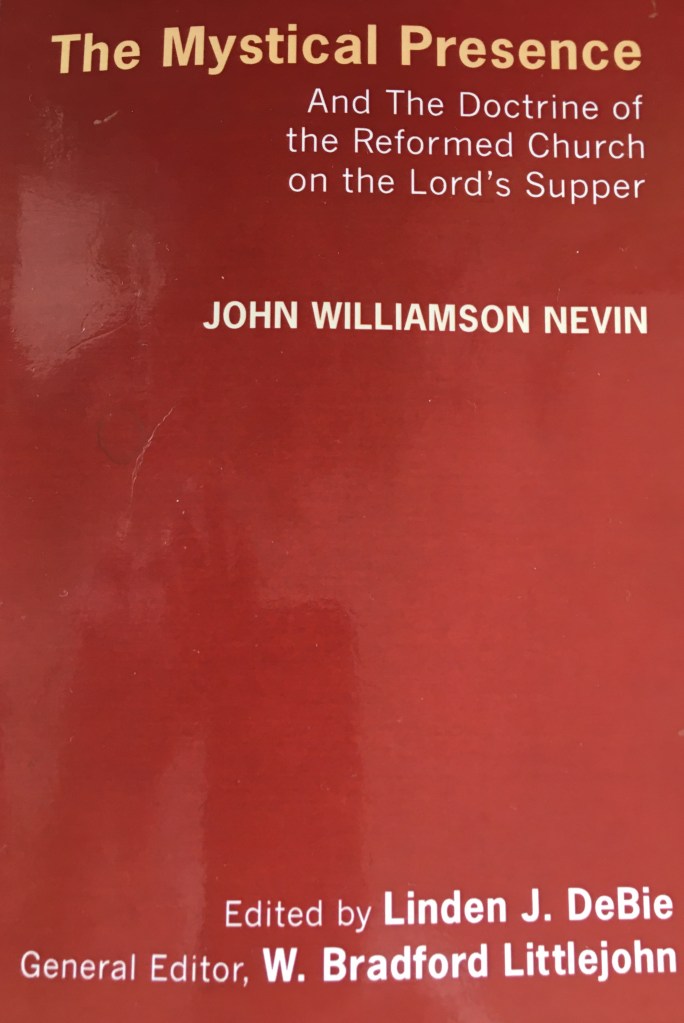
by Linden DeBie
[This article was the second part of the Editor’s Introduction to The Mystical Presence and the Doctrine of the Reformed On the Lord’s Supper by John Williamson Nevin, and appeared under the subheading, The Occasion for Writing the Mystical Presence. It was included in volume part of 1 of the Mercersburg Theology Series published by Wipf and Stock in 2012. At the time Bradford Littlejohn was the series editor. I was responsible for the first edition. Very few changes have been except small grammatical or stylistic changes which are not mentioned. There was enough disagreement by scholars about why Nevin wrote the Mystical Presence that the editors thought it important to cover that topic in the Introduction.]
Scholars of the Mercersburg Movement agree that the immediate cause for writing The Mystical Presence was the charges and suspicion that preceded and followed the heresy trial which occurred at the Synod in York, Pa, 1845, and led to the nearly unanimous vindication of Nevin and Schaff in the subsequent vote.[1]The Classis of Philadelphia had been tipped off by a former Roman Catholic monk, a convert of a Classis leader, the reverend Joseph Berg,[2] that the seminary professors were teaching the real presence of Christ in the Holy Communion and were involved in what came to be known as a “romanizing tendency.”[3] This came at a time when anti-catholic sentiment in the country was at an all-time high, leading to riots in Philadelphia.
In spite of the damaging arguments made by the Classis, the Synod found the professors not guilty of the charges, and yet as a direct result of the trial, the German Reformed Church became fundamentally altered in its theological perspective. This led to the emergence of an anti-Mercersburg faction who felt scandalized by any advocacy of Roman Catholic ideas, regardless of their historic presence in the Reformed creeds and confessions. As this minority continued to make allegations of this romanizing tendency, the Mercersburg professors felt their efforts to lead the denomination were hampered by general confusion over their teachings and lingering questions about their orthodoxy. From the following summer through the spring, articles poured forth from Nevin’s pen in an attempt to justify their exoneration and dispel the confusion over where they stood in regard to Rome.[4] Likewise, their detractors kept up “a constant barrage” of counterargument.[5] However, their vehicle was not just the Weekly Messenger. They were publishing in a wide range of evangelical periodicals that reached well beyond the Germans to the Dutch Reformed, the Lutherans, as well as New England.[6]
These events left many scholars with the legitimate impression that Nevin wrote The Mystical Presence in order to reiterate the professors’ orthodoxy and state their case in clear historical terms with the objective of convincing the remaining doubters and bringing his case to readers beyond those of the Weekly Messenger. However, while that is certainly the case, it might leave one with the impression that the book was exclusively a defense and expansion of the historical research Nevin had undertaken earlier, simply a vindication of his position on the nature of Reformed liturgical practice.
Clearly, in support of the defensive nature of the book, scholars point to the timing: the trial and the letters of protest to the editors of the denomination’s weekly newsletter, The Weekly Messenger of the German Reformed Church. They also cite the fact that a great deal of the research of the book had already been published, encouraging the sense that The Mystical Presence was assembled to solve a problem, clear up confusion, and make a case clearer; the fact of the lingering doubts of many as to the real doctrine of the Reformed on the Lord’s Supper bears witness to that. The subtitle, “a Vindication of the Reformed or Calvinistic Doctrine of the Holy Eucharist,” is convincing testimony, and Nevin’s first paragraph of the book in which he refers directly to the controversy, suggests “case closed.” Nevertheless, Nevin himself pointed out that there was much that was new in the book. Also, the material was extensively reworked incorporating more evidence if not a more coherent argument. And it was perhaps an overstatement for Nevin to say in his introduction that the controversy “has not been permitted to come into view”; he clearly seemed to be of the mind that he was moving beyond the trial and its aftermath.[7]
While accepting that The Mystical Presence was indeed a vindication of the Mercersburg Theology, a broader reason for the occasion of the book can be suggested based on the work of more recent scholars.[8] Their work began with a reassessment of Nevin’s dependence on German culture and ideas and ended with Nevin being placed firmly within his American context.[9] Richard Wentz specifically speaks of an American theologian wrestling with the issues facing a scholar in his own place and time.[10] Indeed, Wentz moves away from looking at Nevin in a defensive posture; although he recognizes the polemicist in Nevin, he is concerned to understand Nevin in thoughtful tension with American theology as it stood, and he understands that Nevin was prepared to take his theology in a new direction.
To some extent their reaction to the common view of Nevin under the spell of German or Anglican theology is understandable.[11] It comes in response to popular claims that Nevin was a romantic, or an Hegelian or of a decidedly mystical bent. These have been oftentimes exaggerated by a less than thorough understanding of how these influences were managed by Nevin. He never gave himself over to any one philosopher, theologian, or historian, but borrowed freely from a variety of sources, which is as American as apple pie. Yet that said, it would be misleading to fail to insist that Nevin drew most deeply from the well of current German theological science, typically as articulated by the German Mediating theologians of his day and of the prior generation.
To their credit, these scholars paved the way to ask anew why did Nevin publish The Mystical Presence? Their insights deepen our inquiry and allow us to seek a broader reach for the book. Such inquiry allows us to ask the question, if Nevin sought merely to clarify his views and vindicate the orthodoxy of the seminary professors, that is, to write a mere defense of his views in hopes of alleviating controversy, why would he include the essay by Karl Ullmann, a leader in the Mediating School of German theology? Nevin was astute enough to know that Ullmann’s essay would only pour fuel on the fire of controversy and further confuse those who were not up to deciphering the complexities of German idealism.
In his article in Reformed Confessionalism in Nineteenth-Century America, Stephen Graham sheds light on this question, helping us recognize a positive or proactive reason for the book. Graham draws from Schaff’s comments on the Mystical Presence that what Nevin was really up to was a “scientific statement and profound enlargement of the view of the Geneva Reformer . . .”[12] The “profound enlargement” is a most interesting observation. What Graham has done, with Schaff’s help, is to give us insight into a positive immediate cause for the book. Here we begin to appreciate the place of The Mystical Presence in the Mercersburg School’s dramatic religious agenda for America, no less evident in Schaff’s previously published and equally controversial The Principle of Protestantism. One cannot read The Principle of Protestantism and Ullmann’s essay without recognizing the bold if obviously (from hindsight) Promethean religious vision for America.
How might this grand vision be equal to its new home and so capture the wider American audience? How might what they believed inevitable, that is, that America would be the next stage of the church’s bold, new historical development, be recognized and broadly proclaimed? After all, Nevin and Schaff had no journal equivalent to Princeton’s far-reaching Biblical Repertory and Princeton Review. And in spite of the popularity of the published tracts such as Nevin’s Anxious Bench, and the ambitious project begun in Schaff’s The Principle of Protestantism, the nascent movement still lacked a flagship book. In fact, it was Nevin’s express desire that the German church have an academic journal that could consider the great questions facing the church. The Mercersburg Review would appear in January 1849 and supply that very need. If Nevin was to reach the wider American Protestant audience it would have to be through the medium of a widely circulated book, The Mystical Presence. (Indeed, it was favorably reviewed in Germany and Great Britain.) Thus, The Mystical Presence became the Mercersburg Seminary leadership’s wider assault on a dominant American, evangelical theological perspective they called “modern Puritanism.” Surely the material of the book was born originally in expression of Reformed sacramental orthodoxy and certainly in defense of those beliefs, but having been seriously maligned, Mercersburg would now use The Mystical Presence to go on the offensive. Even if the book’s essentially narrow subject matter (although Nevin wanders into many other fields, some of them minefields) would obscure that intention and confirm in the minds of most readers the vindicatory nature of the book, The Mystical Presence was a first, broad declaration that Mercersburg sought to replace the dominant American Protestant theology with what today we might call “evangelical catholicism.”
Generally speaking, Mercersburg’s embrace of evangelical catholicism was not only an attempt to recover in essence the doctrine of Calvin for the Lord’s Supper, but also to restore the sacraments to their place of prominence more generally, to stress and elevate church liturgy, and to insist on catechetical instruction over the revivalistic methods then gaining sway over Protestant churches. Finally, they wanted to heal the rift caused by the Reformation, restoring historic catholicity to Protestantism via a critique that would expose the failures of Roman Catholicism as well as the failures of Protestantism, in expectation that a new, higher synthesis might be achieved.
The way Mercersburg
sought to supplant modern Puritanism with evangelical catholicism was to
reintroduce traditional forms, confessions, and theology to the Protestant
church in America; to strongly criticize alternative views, most especially
modern Puritanism as they called it; and to introduce philosophical idealism
and speculative theology as the most scientific, reasonable, and intelligent
support to Christian orthodoxy. Each of these themes features prominently
within the Mystical Presence.
[1] Forty voted in favor of the professors, three voted against, and one abstained.
[2] Joseph Berg was a denominational leader serving the Race Street church in Philadelphia and a vehement anti–Roman Catholic crusader.
[3] Theodore Appel, The Life of John Williamson Nevin, 227–28. Appel is drawing upon Nevin’s article, “Pseudo-Protestantism.” Weekly Messenger of the German Reformed Church, n.s., 10, nos. 48-52 (1845). Full references hereafter can be found in the previous article, “A Brief Biography of John Williamson Nevin.”
[4] All were published in the Weekly Messenger under the general heading, “Pseudo-Protestantism” (nos. 48 through 52, 1845).
[5] James Hastings Nichols, Romanticism in American Theology, 87.
[6] Ibid.
[7] Although Nevin never mentions the trial, its proceedings and result, he frequently refers to the issues that brought about the trial.
[8] It is important to point out that earlier scholars neither fail to mention nor rule out the greater ambitions of the Mercersburg professors. But The Mystical Presence is not typically considered among these ambitions. However, more recent authors push us beyond the merely reactionary bent of The Mystical Presence. See Jonathan Bonomo, Incarnation and Sacrament: The Eucharistic Controversy Between Charles Hodge and John W. Nevin. Eugene, OR: Wipf & Stock, 2010. Bonomo doesn’t even include “vindication” in his list of reasons behind the writing of The Mystical Presence (22). D. G. Hart, on the other hand, makes it clear that Nevin was responding to the charges of Joseph Berg among others in The Mystical Presence, but his point is that Nevin’s “quest” was to “bolster the catechetical system of ecclesial Calvinism . . .” (D.G. Hart, John Williamson Nevin, High Church Calvinist. Phillipsburg, NJ: P&R Publishing, 124), thus opening up additional motives for The Mystical Presence. Likewise, Richard Wentz, throughout his works, sees Nevin wrestling with American church issues and so he brings new considerations before his readers. Bradford Littlejohn is fully aware of the vindicatory roots of The Mystical Presence (The Mercersburg Theology and the Quest for Reformed Catholicity. Eugene, OR: Pickwick Publications, 2009, 16), but he creatively includes some of Nevin’s most poignant insights as he explores the seldom visited issue of Mercersburg Theology and Eastern Orthodoxy (133).
[9] D. G. Hart has argued that Appel and Nichols gave too much credit to Nevin’s adoptive German denomination in framing his theology. Hart insists that Nevin was simply seeking the sacramental and churchly tradition of his youth. (See Hart, John Williamson Nevin, 62.) Likewise, Richard Wentz’s recent book, as the title suggests, is an attempt to identify Nevin as an American theologian. (See Richard Wentz, John Williamson Nevin: American Theologian. New York: OUP, 1997.) Some of these authors have reacted to what they perceive was an overemphasis by previous scholars of Nevin’s dependence on German modes of thought and they point to the wide spectrum of challenging questions he wrestled with, coming at them armed certainly with Continental insights, but also with European as well as American wisdom. (See William DiPuccio, “Nevin’s Idealistic Philosophy,” Reformed Confessionalism in Nineteenth-Century America, edited by Sam Hamstra Jr. and Arie J. Griffioen. Lanham, MD: Scarecrow Press, 1995, 3–67.) DiPuccio finds Nevin’s originality is his incorporation of many streams of thought in his churchly theology. However, caution must be recommended in the case of Hart. Although appealing in its simplicity, it is too facile an argument that Nevin’s sojourn with the German Reformed was an attempt to recapture the church of his youth. His biography never says that, but nostalgically looks back to a tender time in Nevin’s youth. Indeed, one might ask, was Nevin seeking that same warmth of feeling religion when earlier he fell in with the rationalist school? Clearly, Nevin wasn’t compelled by what he could not find in modern Puritanism, but what he did find in German idealism. (In the Introduction I said German “neology” and not “idealism.” I want to correct that here and say that while Nevin was at first smitten by what his Princeton Seminary teachers called German “neology,” he found his way out of neology, preferring the speculative approach of German idealism in its Mediating form. The credit for that belongs to August Neander.)
[10] Richard Wentz, “American Nationalism,” in Reformed Confessionalism, 23-42
[11] Recent scholarship has been marked by a departure from the older, sound view of Nevin as very much influenced by German scholarship, especially that of the Mediating School. David Layman wrote in 1995, “Scholars tend to disregard this living, holistic quality of Nevin’s theology largely because they overestimate his adaptation of German theology to the American context” (“Nevin’s Holistic Supernaturalism,” in Reformed Confessionalism in Nineteenth-Century America, 193). I have replied, “But German confessional idealism was in fact just that, a purveyor of holistic, living theology and it appealed enormously to Nevin. No, he didn’t simply duplicate the German authors without innovation, but it’s impossible not to recognize the degree to which he was indebted to the Mediating philosophical and historical approach” (“Impact of Mercersburg Theology,” 29).
[12] “Nevin and Schaff at Mercersburg,” 73–96, quoting from Appel, John Williamson Nevin, 412, from Philip Schaff, Amerika (Berlin, 1854), 244. This was translated later as America: A Sketch of the Political, Social, and Religious Character of the United States of North America (New York: Scribner’s, 1855; reprint edition by Perry Miller, Cambridge: Harvard University Press, 1961)
 Mercersburg Today